I'm on a plane from Chicago back to Seattle. Internet on the plane - amazing. I was out for a just a single night so I could present at the UBM Canon ASQ Quality Expo at McCormick Place. Just enough time for breakfast at my favorite diner (11 City Diner, 11th and Wabash) and a jumbo Chicago dog at the stand across from the Alaska Airlines gate. The topic was "Solving Supply Chain Problems Proactively". Apollo President Chris Eckert and I presented this same topic this year at the ASQ World Conference on Quality and Improvement in Pittsburgh, PA a few months ago. I never miss a chance to go to Chicago - one of my favorite cities - even if it's only for a day.
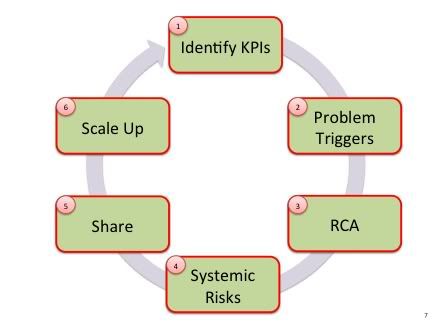
We like to take the opportunity to show root cause analysis as a proactive tool. Most people think that RCA is purely reactive, meaning that it's only any good once something bad has happened. There's some truth to it - we generally apply RCA to events that have already occurred. In that sense, one of the primary outcomes is to identify corrective actions. Corrective actions fix known errors. But what about preventive actions - those actions that help reduce the risk of potential future problems from occurring? That would be a great proactive outcome of an RCA. Yet many people don't do this - and I'm not sure why not. It's not that difficult. Let me see if I can walk you through six simple steps in a few hundred words...
Step One: Identify KPI's
KPI's are Key Process Indices. (FYI: I'm not too proud to link to Wikipedia for this blog. If you want to do more research, use the links at the bottom of the Wikipedia page.) Every company has KPI's. Examples include specification of tolerances, delivery times, scrap, downtime, and any other measurement of performance you can think of. KPI's derive from goals and objectives. Identify the primary KPI's for your business. You'll need them in the next step.
Step Two: Identify Problem Triggers
Problem triggers are significant deviations from your KPI's. When a deviation is significant, it should trigger a root cause analysis. You need to define these triggers, but be careful. Most set their thresholds too low, which trigger more investigations than they are able to adequately complete. This leads to suboptimal results. Be conservative at first, and then tighten thresholds down once you are sure your team has the capability to keep up with the investigations they trigger.
Step Three: Perform RCA
An organization needs to commit to a single RCA process, and they need to do it well. If you aren't sure which process is best, give us a call... we'll help you sort it out. But a single RCA methodology is crucial to success. Everyone needs to speak the same language. The notion that people can use whatever they want as long as it works for them is detrimental to the program. Make a commitment! Evaluate what's out there and commit to one process. And if you're serious about it, you'll realize that the 5 Whys and Fishbone are completely outclassed by several modern RCA options, of which Apollo is one. Things change for the better over time, and RCA is no different.
Step Four: Identify Systemic Risks
This is where the real proactive opportunities are found. Most analyses will lead to systemic causes, but only if they go far enough. These are causes that are actually part of the system itself. They have been a cause of problems in the past, and will likely be a cause of problems in the future. Finding and eliminating these causes is truly more "preventive" than "corrective". And they can be found in almost any root cause analysis - as long as the investigator goes far enough and knows what to look for. Common cause analysis is a great way to identify systemic risks.
Step Five: Share with Others
Many companies simply don't take reporting seriously. Think I'm wrong? Pull some of your incident reports and review them critically. Do they tell you what the problem was, when it happened, where it happened, and what the significance of the problem was? Do they tell you the causes of the problem? Do they contain a detailed cause summary? Do they provide you with evidence for the causes? And do they identify solutions that directly impact those causes? These are just the basics, but if you've answered yes to all of them then your company stands apart from most. We need to share what we've learned so that others can benefit from our efforts. This leads to true organizational learning.
Step Six: Scale Up!
Once you've proven that you can make this work on a smaller scale, it's not difficult to step it up a notch or two.
That's 550 words including with headers. I could probably shrink it, but we're landing soon... time to power down...
Showing posts with label Apollo root cause analysis. Show all posts
Tuesday, September 20, 2011
Friday, April 15, 2011
Newest Sleep Aid: Controlling Aircraft After Midnight
There's a lot of talk about air traffic controllers falling asleep on the job these days. First at Reagan in Washington DC, then apparently at other airports - including Reno and Boeing Field here in Seattle. In each case, the dozing employee was suspended. And today, we find out that the Chief Operating Officer of Air Traffic Organization Hank Krakowski has resigned from his post. FAA Administrator Randy Babbitt had this to say:
"Over the last few weeks, we have seen examples of unprofessional conduct on the part of a few individuals that have rightly caused the traveling public to question our ability to ensure their safety. This conduct must stop immediately."
The FAA is also adding air traffic controllers to midnight shifts at 27 towers in different cities around the US. But as a frequent flyer, I have to ask myself if I feel safer as a result of these actions and tough rhetoric. Any of you who have been through our root cause analysis training know that disciplinary action employed as a solution strategy raises red flags because it is seldom effective at actually reducing risk. Were errors made in these cases? Undoubtedly - but it doesn't take a professional investigator to figure that out.
I'm a fan of James Reason and his approach to understanding and managing human error. While I don't subscribe to his categorization model for accidents, I do find his analysis of how errors come to pass very useful. My understanding of it goes like this:
You can't commit an error without intent. In other words, you need to have intent as a motivator for your actions in order to commit an error - otherwise it's just an involuntary response. Drooling on your pillow while sleeping, for example, is not an error because there was no prior intent. In this case, the air traffic controllers did have an intention - which was to safely manage the air traffic in the airspace for which they were responsible.
The next question is whether the actions proceeded as planned. From the articles I've read, it would appear that in most of these cases, the answer to this would be no - the air traffic controllers did not plan to fall asleep on the job. One exception to this was in Knoxville TN where the controller apparently made a bed on the floor of the control tower out of pillows and slept for 5 hours. That's another story, but one that likely still shares many causes.
When actions proceed as planned, and they achieve the desired results, then there's no problem. In fact - this is what happens most of the time. But in the case of the air traffic controllers, we see that this wasn't the case. So now what?
Reason has developed a decision tree to assess culpability, which can be found in it's original form on page 209 of his book Managing the Risks of Organizational Accidents. There are various customized forms of this model, but they each subject the error to a series of tests to determine whether disciplinary action would effectively reduce the risk of recurrence. The following is based on a modified version of Reason's decision tree.
First is the Deliberate Harm test. Were the actions intended to cause harm? If so, then disciplinary action is absolutely appropriate. Did the air traffic controllers intend deliberate harm? I think the answer is no - not in any of the cases.
The next is the Health test, which examines whether there were underlying medical conditions that resulted in the error. I would say that the air traffic controllers were not fit for duty due to the fact that they could not stay awake during their shifts. Therefore disciplinary action is not likely to be an effective solution strategy. Effective solutions are effective only because they control one or more causes of the problem. And I don't think you can control a health problem with punishment.
The next test examines the Procedures that govern behavior. Did the employee violate established procedures? And if so, were the procedures clear, correct, safe, and being followed by others? In the case of the air traffic controllers, I think the answer to the first part of this test is yes - each of them violated established rules against sleeping on shift. The second part of the test though is harder to answer accurately without in-depth analysis and interviews, particularly whether or not the procedures were being followed by others. I suspect these procedures were violated as a matter of course, although I can't back it up.
The final test examines whether or not someone with similar training/position would have likely acted in the same way in a similar situation. Given the fact that so many instances have come to light, I think the answer to this question is yes - they have acted in a similar fashion in the past, and will likely do so again in the future if no changes are made.
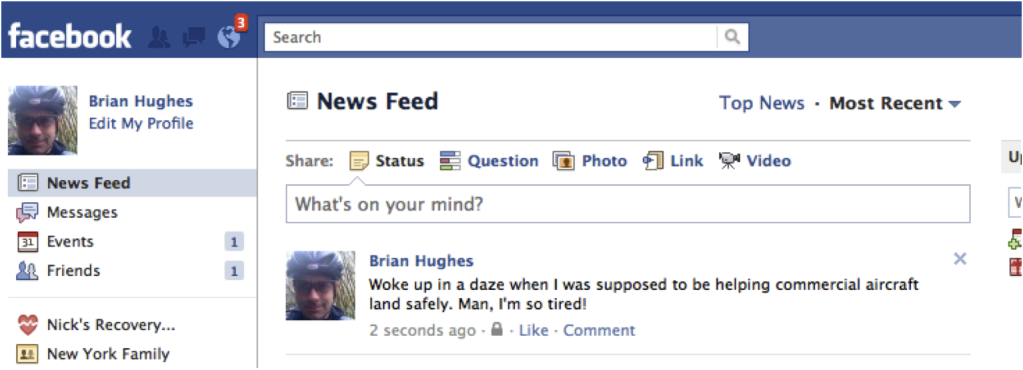
Last night I saw a segment on the PBS News Hour that included Alan Levin, who covers aviation for USA Today. In this interview, and in his April 14, 2011 article in USA Today, Levin discusses systemic fatigue as a problem throughout the air traffic control group at the FAA. The FAA has apparently known about this problem for some time now, according to this article. That shouldn't be news to anyone familiar with the patterns of undesirable events. For every incident that comes to light, there are several that no one found out about. I think it's safe to say that air traffic controllers frequently fall asleep on the job during this midnight shift and that they don't post it as a status update on their Facebook page:
In the News Hour interview, Levin goes on to discuss how structured napping has been proven to help alleviate fatigue but that no one will propose this as a solution because it won't pass the "Jay Leno" test... in other words, it would be ridiculed non-stop by late night comedians as well as politicians.
At the end of the day, this drama shows just how far we have to go with respect to managing human error. The solutions proposed include the resignation of a high level manager, the suspension and likely dismissal of 6 air traffic controllers, and the expressed outrage of FAA Administrator Randy Babbitt. I hope they don't stop here, but if the story dies that's likely going to happen.
Whew... I feel like they've really gotten to the bottom of this one.
An updated article from the Seattle Times... worth reading if you have a few minutes...
Another updated article... the hits keep coming!
"Over the last few weeks, we have seen examples of unprofessional conduct on the part of a few individuals that have rightly caused the traveling public to question our ability to ensure their safety. This conduct must stop immediately."
The FAA is also adding air traffic controllers to midnight shifts at 27 towers in different cities around the US. But as a frequent flyer, I have to ask myself if I feel safer as a result of these actions and tough rhetoric. Any of you who have been through our root cause analysis training know that disciplinary action employed as a solution strategy raises red flags because it is seldom effective at actually reducing risk. Were errors made in these cases? Undoubtedly - but it doesn't take a professional investigator to figure that out.
I'm a fan of James Reason and his approach to understanding and managing human error. While I don't subscribe to his categorization model for accidents, I do find his analysis of how errors come to pass very useful. My understanding of it goes like this:
You can't commit an error without intent. In other words, you need to have intent as a motivator for your actions in order to commit an error - otherwise it's just an involuntary response. Drooling on your pillow while sleeping, for example, is not an error because there was no prior intent. In this case, the air traffic controllers did have an intention - which was to safely manage the air traffic in the airspace for which they were responsible.
The next question is whether the actions proceeded as planned. From the articles I've read, it would appear that in most of these cases, the answer to this would be no - the air traffic controllers did not plan to fall asleep on the job. One exception to this was in Knoxville TN where the controller apparently made a bed on the floor of the control tower out of pillows and slept for 5 hours. That's another story, but one that likely still shares many causes.
When actions proceed as planned, and they achieve the desired results, then there's no problem. In fact - this is what happens most of the time. But in the case of the air traffic controllers, we see that this wasn't the case. So now what?
Reason has developed a decision tree to assess culpability, which can be found in it's original form on page 209 of his book Managing the Risks of Organizational Accidents. There are various customized forms of this model, but they each subject the error to a series of tests to determine whether disciplinary action would effectively reduce the risk of recurrence. The following is based on a modified version of Reason's decision tree.
First is the Deliberate Harm test. Were the actions intended to cause harm? If so, then disciplinary action is absolutely appropriate. Did the air traffic controllers intend deliberate harm? I think the answer is no - not in any of the cases.
The next is the Health test, which examines whether there were underlying medical conditions that resulted in the error. I would say that the air traffic controllers were not fit for duty due to the fact that they could not stay awake during their shifts. Therefore disciplinary action is not likely to be an effective solution strategy. Effective solutions are effective only because they control one or more causes of the problem. And I don't think you can control a health problem with punishment.
The next test examines the Procedures that govern behavior. Did the employee violate established procedures? And if so, were the procedures clear, correct, safe, and being followed by others? In the case of the air traffic controllers, I think the answer to the first part of this test is yes - each of them violated established rules against sleeping on shift. The second part of the test though is harder to answer accurately without in-depth analysis and interviews, particularly whether or not the procedures were being followed by others. I suspect these procedures were violated as a matter of course, although I can't back it up.
The final test examines whether or not someone with similar training/position would have likely acted in the same way in a similar situation. Given the fact that so many instances have come to light, I think the answer to this question is yes - they have acted in a similar fashion in the past, and will likely do so again in the future if no changes are made.
Last night I saw a segment on the PBS News Hour that included Alan Levin, who covers aviation for USA Today. In this interview, and in his April 14, 2011 article in USA Today, Levin discusses systemic fatigue as a problem throughout the air traffic control group at the FAA. The FAA has apparently known about this problem for some time now, according to this article. That shouldn't be news to anyone familiar with the patterns of undesirable events. For every incident that comes to light, there are several that no one found out about. I think it's safe to say that air traffic controllers frequently fall asleep on the job during this midnight shift and that they don't post it as a status update on their Facebook page:
In the News Hour interview, Levin goes on to discuss how structured napping has been proven to help alleviate fatigue but that no one will propose this as a solution because it won't pass the "Jay Leno" test... in other words, it would be ridiculed non-stop by late night comedians as well as politicians.
At the end of the day, this drama shows just how far we have to go with respect to managing human error. The solutions proposed include the resignation of a high level manager, the suspension and likely dismissal of 6 air traffic controllers, and the expressed outrage of FAA Administrator Randy Babbitt. I hope they don't stop here, but if the story dies that's likely going to happen.
Whew... I feel like they've really gotten to the bottom of this one.
An updated article from the Seattle Times... worth reading if you have a few minutes...
Another updated article... the hits keep coming!
Sunday, March 27, 2011
What kind of rider are you?
It's Sunday morning... 6:30am. I've been up for an hour drinking coffee, eating breakfast, and scanning headlines. In a while, I'll dress myself in weather-appropriate biking gear and head out to meet friends for a 70 mile road ride in the rain. It's not everyone's idea of a perfect Sunday morning - I'll admit. But I'm a happier, more rounded person if I can burn off a few thousand calories several times a week. That means the people in my life find it easier to be around me... me included.
Sometimes the weather here in Seattle is less than ideal. That's because it really does rain here. October through June are generally wet months. What's a rider to do? Head indoors, of course. I belong to a gym that offers spin classes. In years past, I didn't have a lot of respect for the spinners. Why belong to a gym when you can just ride your bike? Duh! But after some prompting by my significant other ("You are driving me nuts, and not in a good way. Please, join a gym.") during an extended period off the bike due to weather, I tried it out. That first hour of spin class was one of the hardest hours of my life. Thoroughly humbled, I hobbled back home, grateful that I could train in a meaningful way indoors during the bad months.
I settled into a routine... spinning at least twice a week, and riding my bike as often as possible. What a great combo. But what became apparent to me was that the two groups of riders - spinners and cyclists - generally don't interact that much. Many cyclists never set foot in a spin class. And many spinners would feel extremely awkward clipping into a bicycle. In fact, there are even terms to help delineate the two activities - riding "outside" and "inside". "Do you ride outside?" my instructor/tormentor asked. I found out that she was exclusively an inside rider.
So what does this have to do with root cause analysis, you may ask?
When Apollo hosts training classes, attendees are "riding inside". The instructor has a lesson plan, manual, and example exercises. He/she fits the course regimen to the individual characteristics of each class. Investigation and analysis are simulated. It's a challenging class. But it's fun too - and students get a lot of value out of being challenged in the "inside" setting. It's also safe. There are no cars, potholes, slippery roads, jerky drivers, slippery manhole covers, drunk UFC fans (seriously)... nothing that will cause you physical harm. Root cause investigators put themselves at risk in the real world. They are held out to be experts. Their work is visible and often of great interest to the organization. But not while in the classroom... that's an intentionally safe environment.
But training is not just for fun. Once class is over, it's time to go to put your skills to work outside. Many RCA Facilitators find their first real investigation to be uncomfortable. This is because they are juggling two new and challenging tasks at once - analyzing a problem with a new methodology and facilitating a group of diverse, often skeptical, experts. Add to that the fact that many times people wait several weeks before putting their new skills to work... not a good idea. The skills you pick up in training have a half-life as does your confidence in those skills. Many attendees find out the hard way that they don't match up. Confidence remains high longer than the skills remain sharp.
To get the most out of root cause analysis training, we recommend you get started "riding outside" as soon as possible after class. No excuses - just do it (where have I heard that before?). What are you waiting for? A catastrophe? Believe me, that's no time to start.
Begin easy - don't put yourself at too much risk. Pick something simple, something that can be completed in a few hours. And then do it again at least two more times as soon as possible after class. This consolidates what you learned inside. You will effectively bridge the gap between the simulated class environment and the real-world investigative process. Involving others from your training will help. Take turns leading and offer helpful critique. And get your Apollo instructor involved - he/she will be more than happy to offer advice.
@brian_hughes
Sometimes the weather here in Seattle is less than ideal. That's because it really does rain here. October through June are generally wet months. What's a rider to do? Head indoors, of course. I belong to a gym that offers spin classes. In years past, I didn't have a lot of respect for the spinners. Why belong to a gym when you can just ride your bike? Duh! But after some prompting by my significant other ("You are driving me nuts, and not in a good way. Please, join a gym.") during an extended period off the bike due to weather, I tried it out. That first hour of spin class was one of the hardest hours of my life. Thoroughly humbled, I hobbled back home, grateful that I could train in a meaningful way indoors during the bad months.
I settled into a routine... spinning at least twice a week, and riding my bike as often as possible. What a great combo. But what became apparent to me was that the two groups of riders - spinners and cyclists - generally don't interact that much. Many cyclists never set foot in a spin class. And many spinners would feel extremely awkward clipping into a bicycle. In fact, there are even terms to help delineate the two activities - riding "outside" and "inside". "Do you ride outside?" my instructor/tormentor asked. I found out that she was exclusively an inside rider.
So what does this have to do with root cause analysis, you may ask?
When Apollo hosts training classes, attendees are "riding inside". The instructor has a lesson plan, manual, and example exercises. He/she fits the course regimen to the individual characteristics of each class. Investigation and analysis are simulated. It's a challenging class. But it's fun too - and students get a lot of value out of being challenged in the "inside" setting. It's also safe. There are no cars, potholes, slippery roads, jerky drivers, slippery manhole covers, drunk UFC fans (seriously)... nothing that will cause you physical harm. Root cause investigators put themselves at risk in the real world. They are held out to be experts. Their work is visible and often of great interest to the organization. But not while in the classroom... that's an intentionally safe environment.
But training is not just for fun. Once class is over, it's time to go to put your skills to work outside. Many RCA Facilitators find their first real investigation to be uncomfortable. This is because they are juggling two new and challenging tasks at once - analyzing a problem with a new methodology and facilitating a group of diverse, often skeptical, experts. Add to that the fact that many times people wait several weeks before putting their new skills to work... not a good idea. The skills you pick up in training have a half-life as does your confidence in those skills. Many attendees find out the hard way that they don't match up. Confidence remains high longer than the skills remain sharp.
To get the most out of root cause analysis training, we recommend you get started "riding outside" as soon as possible after class. No excuses - just do it (where have I heard that before?). What are you waiting for? A catastrophe? Believe me, that's no time to start.
Begin easy - don't put yourself at too much risk. Pick something simple, something that can be completed in a few hours. And then do it again at least two more times as soon as possible after class. This consolidates what you learned inside. You will effectively bridge the gap between the simulated class environment and the real-world investigative process. Involving others from your training will help. Take turns leading and offer helpful critique. And get your Apollo instructor involved - he/she will be more than happy to offer advice.
@brian_hughes
Subscribe to:
Posts (Atom)