I'm on a plane from Chicago back to Seattle. Internet on the plane - amazing. I was out for a just a single night so I could present at the UBM Canon ASQ Quality Expo at McCormick Place. Just enough time for breakfast at my favorite diner (11 City Diner, 11th and Wabash) and a jumbo Chicago dog at the stand across from the Alaska Airlines gate. The topic was "Solving Supply Chain Problems Proactively". Apollo President Chris Eckert and I presented this same topic this year at the ASQ World Conference on Quality and Improvement in Pittsburgh, PA a few months ago. I never miss a chance to go to Chicago - one of my favorite cities - even if it's only for a day.
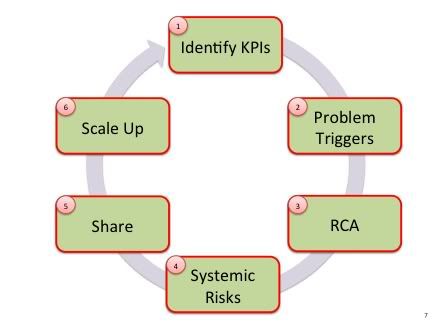
We like to take the opportunity to show root cause analysis as a proactive tool. Most people think that RCA is purely reactive, meaning that it's only any good once something bad has happened. There's some truth to it - we generally apply RCA to events that have already occurred. In that sense, one of the primary outcomes is to identify corrective actions. Corrective actions fix known errors. But what about preventive actions - those actions that help reduce the risk of potential future problems from occurring? That would be a great proactive outcome of an RCA. Yet many people don't do this - and I'm not sure why not. It's not that difficult. Let me see if I can walk you through six simple steps in a few hundred words...
Step One: Identify KPI's
KPI's are Key Process Indices. (FYI: I'm not too proud to link to Wikipedia for this blog. If you want to do more research, use the links at the bottom of the Wikipedia page.) Every company has KPI's. Examples include specification of tolerances, delivery times, scrap, downtime, and any other measurement of performance you can think of. KPI's derive from goals and objectives. Identify the primary KPI's for your business. You'll need them in the next step.
Step Two: Identify Problem Triggers
Problem triggers are significant deviations from your KPI's. When a deviation is significant, it should trigger a root cause analysis. You need to define these triggers, but be careful. Most set their thresholds too low, which trigger more investigations than they are able to adequately complete. This leads to suboptimal results. Be conservative at first, and then tighten thresholds down once you are sure your team has the capability to keep up with the investigations they trigger.
Step Three: Perform RCA
An organization needs to commit to a single RCA process, and they need to do it well. If you aren't sure which process is best, give us a call... we'll help you sort it out. But a single RCA methodology is crucial to success. Everyone needs to speak the same language. The notion that people can use whatever they want as long as it works for them is detrimental to the program. Make a commitment! Evaluate what's out there and commit to one process. And if you're serious about it, you'll realize that the 5 Whys and Fishbone are completely outclassed by several modern RCA options, of which Apollo is one. Things change for the better over time, and RCA is no different.
Step Four: Identify Systemic Risks
This is where the real proactive opportunities are found. Most analyses will lead to systemic causes, but only if they go far enough. These are causes that are actually part of the system itself. They have been a cause of problems in the past, and will likely be a cause of problems in the future. Finding and eliminating these causes is truly more "preventive" than "corrective". And they can be found in almost any root cause analysis - as long as the investigator goes far enough and knows what to look for. Common cause analysis is a great way to identify systemic risks.
Step Five: Share with Others
Many companies simply don't take reporting seriously. Think I'm wrong? Pull some of your incident reports and review them critically. Do they tell you what the problem was, when it happened, where it happened, and what the significance of the problem was? Do they tell you the causes of the problem? Do they contain a detailed cause summary? Do they provide you with evidence for the causes? And do they identify solutions that directly impact those causes? These are just the basics, but if you've answered yes to all of them then your company stands apart from most. We need to share what we've learned so that others can benefit from our efforts. This leads to true organizational learning.
Step Six: Scale Up!
Once you've proven that you can make this work on a smaller scale, it's not difficult to step it up a notch or two.
That's 550 words including with headers. I could probably shrink it, but we're landing soon... time to power down...
Showing posts with label supply chain. Show all posts
Tuesday, September 20, 2011
Monday, May 23, 2011
Designed by Apple in California, Fatalities and Production Delays by Foxconn in China?
Last week I traveled to Pittsburgh with Chris Eckert (Apollo President) to give a presentation titled "Solving Supply Chain Problems Proactively" at the ASQ World Conference on Quality. We didn't have a packed house, but it was nice to see approximately 75 attendees, especially on the day after the exhibit hall closed down. Our presentation discussed how the supply chain benefits when different links in the chain team up to solve problems. It was a timely discussion in light of the global supply chain problems experienced since the tsunami in Japan dramatically delayed production and delivery of critical components. The risks of sourcing globally are difficult to estimate - particularly when taking natural disasters (and their man-made multipliers, ie Fukushima) into account. Add in the trend towards leaning out inventories, caused by the need to demonstrate to investors and analysts that a company is not tying up cash needlessly (you can think of it as 'just in time' rather than 'just in case', which I can't take credit for coining) and you can see just how vulnerable the supply chain really is. It makes me wonder if companies that have proven to be most vulnerable to supply chain disruptions post-tsunami have robust root cause analysis/problem management processes in place. If so, did these systems uncover proactive opportunities to identify and mitigate the risks of such disruptions? It would be an interesting comparison.
Today, I read an article about how a dust explosion at the Foxconn factory in Chengdu, China was threatening to delay delivery of Apple's latest iPad 2. This is actually what prompted me to write - I owed an entry regarding ASQ last week and this was the perfect prompt. I actually knew just a bit about Foxconn and the iPad, but only as much as one can learn by attending the one man act "The Agony and Ecstasy of Steve Jobs", a monologue by Mike Daisey currently playing here in Seattle at the Rep. It describes the author/actor's obsession with all things Apple and his discovery that these little nuggets of technical perfection are actually created by humans. I learned (if Daisey can be believed) that the Foxconn factory Shenzhen, Guangdong Province of China, employs 250,000 people. They have 10 cafeterias that each seat 25,000. They don't just make iPads or iPhones, but electronics for many different companies. This is a little different than big factories I've visited here in the States. I've been to the Boeing plant in Everett, WA many times. It's the largest enclosed space in the world (click the link above to see it - Boeing has a great aerial shot on their website and it's amazing). They make all the wide-bodied Boeing planes there. And they employee nothing close to 250,000 workers. Foxconn's huge factories are the physical manifestation of the global supply chain at work.
Back to the story. The iPad 2 is selling like gangbusters. I wanted to buy one for my Dad, but found out that I'd have to line up at 6:00am or earlier if I wanted one. I got him a jacket instead (Adam Smith's invisible hand?). What could be worse for Apple than a delay in delivery at this crucial time?
Apple may design their products in California, but they manufacture products in China to take advantage of state of the art production facilities and cheap labor. Basically, the savings more than offset the cost of transportation. By concentrating production with Foxconn in two facilities, they can reduce costs by negotiating more favorable production prices. However, they also take on more risk by placing their eggs in a single basket. Add in lean inventories (due to demand, management, or both) and a disruption could cause Apple to delay sales, which could in turn cool the public's interest in the new iPad prematurely. Millions of dollars are at stake. But that's not all. One quote from the story stood out...
"There probably is going to be no impact" if production resumes as expected in the next few days, said Citigroup analyst Kevin Chang in Taipei. "If this safety inspection drags on for two or three weeks, then there will be an impact on production."
Did I mention that the article reported that 3 people were killed and 15 were injured in this dust explosion? We teach in class that there is no such thing as a "safety" problem, a "quality" problem, or a "supply chain" problem. There are problems which impact various goals of an organization - but problems themselves don't respect our carefully defined boundaries. Kevin Chang of Citigroup seems to think that Foxconn's biggest problem is making sure that investigators pencil-whip up a safety report asap, because if not there may be an impact on production.
Is it just me, or does it seem like Kevin Chang isn't getting the bigger picture? It's not just a safety problem, Kevin. But the fact that this explosion had a - how to say it - negative impact on Foxconn's safety goals did bring the problem to light. Now I'd be speculating if I were to start listing out causes of the dust explosion. And I'd also be speculating if I were to say that the safety standards in Chinese factories are woefully low compared to factories here in the USA. But I'm not speculating when I say that there are very often precursors to a catastrophe such as this. A mature root cause analysis/problem management program would likely have identified these precursors and provided Foxconn with an opportunity to reduce these risks before they manifested into this outcome, which had both a safety impact as well as a production impact.
I'll get to the point. Companies that outsource often make the mistake of thinking they've outsourced the risks along with the work, but that's not true. I'm no protectionist...I'm a proponent of "whatever-makes-the-most-sense sourcing". But however you decide to set up the supply chain, you will maximize returns by implementing a common problem management effort that transcends organizational boundaries. That means Apple ought to be involved in this investigation, just as if the explosion occurred at One Infinite Loop, Cupertino CA. Hopefully that's the case...
Today, I read an article about how a dust explosion at the Foxconn factory in Chengdu, China was threatening to delay delivery of Apple's latest iPad 2. This is actually what prompted me to write - I owed an entry regarding ASQ last week and this was the perfect prompt. I actually knew just a bit about Foxconn and the iPad, but only as much as one can learn by attending the one man act "The Agony and Ecstasy of Steve Jobs", a monologue by Mike Daisey currently playing here in Seattle at the Rep. It describes the author/actor's obsession with all things Apple and his discovery that these little nuggets of technical perfection are actually created by humans. I learned (if Daisey can be believed) that the Foxconn factory Shenzhen, Guangdong Province of China, employs 250,000 people. They have 10 cafeterias that each seat 25,000. They don't just make iPads or iPhones, but electronics for many different companies. This is a little different than big factories I've visited here in the States. I've been to the Boeing plant in Everett, WA many times. It's the largest enclosed space in the world (click the link above to see it - Boeing has a great aerial shot on their website and it's amazing). They make all the wide-bodied Boeing planes there. And they employee nothing close to 250,000 workers. Foxconn's huge factories are the physical manifestation of the global supply chain at work.
Back to the story. The iPad 2 is selling like gangbusters. I wanted to buy one for my Dad, but found out that I'd have to line up at 6:00am or earlier if I wanted one. I got him a jacket instead (Adam Smith's invisible hand?). What could be worse for Apple than a delay in delivery at this crucial time?
Apple may design their products in California, but they manufacture products in China to take advantage of state of the art production facilities and cheap labor. Basically, the savings more than offset the cost of transportation. By concentrating production with Foxconn in two facilities, they can reduce costs by negotiating more favorable production prices. However, they also take on more risk by placing their eggs in a single basket. Add in lean inventories (due to demand, management, or both) and a disruption could cause Apple to delay sales, which could in turn cool the public's interest in the new iPad prematurely. Millions of dollars are at stake. But that's not all. One quote from the story stood out...
"There probably is going to be no impact" if production resumes as expected in the next few days, said Citigroup analyst Kevin Chang in Taipei. "If this safety inspection drags on for two or three weeks, then there will be an impact on production."
Did I mention that the article reported that 3 people were killed and 15 were injured in this dust explosion? We teach in class that there is no such thing as a "safety" problem, a "quality" problem, or a "supply chain" problem. There are problems which impact various goals of an organization - but problems themselves don't respect our carefully defined boundaries. Kevin Chang of Citigroup seems to think that Foxconn's biggest problem is making sure that investigators pencil-whip up a safety report asap, because if not there may be an impact on production.
Is it just me, or does it seem like Kevin Chang isn't getting the bigger picture? It's not just a safety problem, Kevin. But the fact that this explosion had a - how to say it - negative impact on Foxconn's safety goals did bring the problem to light. Now I'd be speculating if I were to start listing out causes of the dust explosion. And I'd also be speculating if I were to say that the safety standards in Chinese factories are woefully low compared to factories here in the USA. But I'm not speculating when I say that there are very often precursors to a catastrophe such as this. A mature root cause analysis/problem management program would likely have identified these precursors and provided Foxconn with an opportunity to reduce these risks before they manifested into this outcome, which had both a safety impact as well as a production impact.
I'll get to the point. Companies that outsource often make the mistake of thinking they've outsourced the risks along with the work, but that's not true. I'm no protectionist...I'm a proponent of "whatever-makes-the-most-sense sourcing". But however you decide to set up the supply chain, you will maximize returns by implementing a common problem management effort that transcends organizational boundaries. That means Apple ought to be involved in this investigation, just as if the explosion occurred at One Infinite Loop, Cupertino CA. Hopefully that's the case...
Subscribe to:
Posts (Atom)